
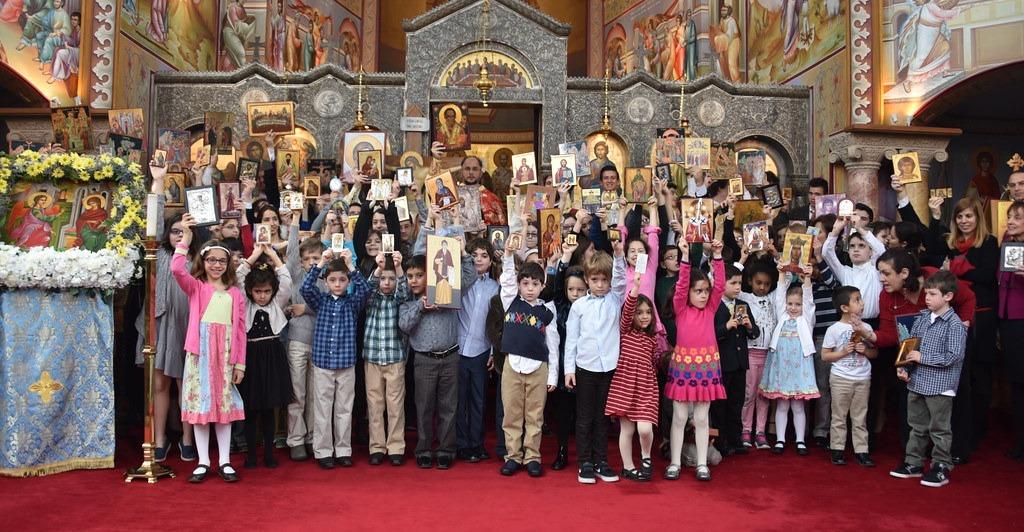
Fr. Dr. Andria Saria In the name of the Father, and of the Son, and of the Holy Spirit. One God, Amen. The Triumph of Orthodoxy may sound like a celebration of victory over someone, but this is not the case. We do not rejoice in defeating others.
Christ teaches us to love everyone, to care for all, and to seek the good of every soul. So, what does this day truly celebrate? The Orthodox Church celebrates that it has preserved the truth of Christ. It is a joy for the gift of faith, the wisdom of the Fathers, and the courage of those who defended the Church in times of trial. History reminds us that even the greatest saints were often condemned.
Maximus the Confessor, John Chrysostom, Gregory Palamas, and John of Damascus, all faced rejection or exile, but their faith remained steadfast. The Triumph of Orthodoxy, historically, marks the restoration of holy icons and the defeat of iconoclasm. This was not a victory over people, but over fanaticism and misunderstanding. Icons are not idols; they are windows to heaven. We honor them because they reveal God’s presence and guide our hearts toward Him.
Worship belongs to God alone. The respect we give to saints, angels, or icons always leads us to God, filling us with grace. Before Christ, the faithful did not have images or direct representations of God. Only after His Incarnation, in the first century, could physical images of Him exist. Yet, in the 8th century, a heresy called iconoclasm arose, bringing suffering and destruction.
Even Emperor Leo III, courageous in battle, misunderstood the purpose of icons. Patriarch Germanus and Saint John of Damascus explained that icons connect matter and spirit, making the invisible visible. Icons teach us that all creation reflects God and reminds us that humans are made in His image. Despite persecution, exile, and destruction of art, the Church defended the truth. The Seventh Ecumenical Council in 787 condemned iconoclasm, and Empress Theodora restored the veneration of icons in 842.
Since then, the Orthodox Church celebrates the Triumph of Orthodoxy on the first Sunday of Great Lent, a day of joy, not for triumph over people, but for the preservation of truth and faith. Now I would like to speak about the coming of Jesus Christ into this world, because I said that this is one of the main reasons why we have icons. When Christ came, what was special about humanity at that moment? Did Christ come because people were especially holy and successful? Or did He come because all humanity was in crisis and needed salvation?
Why did the icon of Christ become necessary in that time and in that century? Why did Christ accept the image of His own creation? And why was this Image crucified? Just as the iconoclasts later burned icons, why did the prophets speak about Him beforehand? There is another serious question: Have we become better since the day Christ gave us His image?
We can find both positive and negative answers. In some ways we became better, in other ways worse. Does the insult against the icon of Christ continue even today? When does a modern person overcome iconoclasm? Iconoclasm is not only about destroying painted icons.
It is when we fight against our neighbors, who are created in the image and likeness of God. In the Gospel, when the Pharisees brought to Christ a woman who, in their opinion, lived a sinful life, Christ said: “Let the one who is without sin cast the first stone. ” We may also say: let the first stone be thrown against the icon. They left, and the woman remained alone. Irenaeus of Lyons says that theology first became more complex.
In the Old Testament, it was simple: one God of Abraham, Isaac, and Jacob. But when Jesus Christ came in the flesh, everything became deeper and more difficult. This should not make us sad, because in this depth we see the beauty of Orthodoxy. Through the icon of Christ, we understand His dogmas. This means faith and prayerful union with the Lord.
Who is Christ, and why do we celebrate Him? And how is Christian salvation connected to this? If we answer too shortly, misunderstandings will appear. That is why we need spiritual prayer and contemplation through icons. Jesus said that Abraham saw Him.
How did Abraham see Him? Not physically, but spiritually. In the same way, by contemplating the icon, we may also see the Lord. When Christ says, “I and the Father are one,” these words are difficult, just like accepting icons. Someone might wrongly interpret this in a pantheistic or reincarnation way.
But Christ does not speak about karma or rebirth. There is nothing pantheistic in His words. The iconoclasts used the words of the Apostle Paul about the Resurrection and Ascension: even if we once knew Christ according to the flesh, now we know Him differently. They argued that icons show Christ before the Resurrection, not the glorified Christ. Therefore, they said, we do not need icons.
However, the Second Council of Nicaea answered: this is truly Christ, fully God and fully man. This union is eternal and inseparable. Therefore, He can be depicted even after the Ascension and in His glory. Who is Jesus as presented in the icon and in the Gospel? We have answers, but not a complete and final answer.
It would be dangerous to claim that we fully understand God, as if He were only an object of human imagination. Orthodox teaching is careful. When something is false, we reject it and say clearly that it is wrong. But when something is a mystery, we honestly call it a mystery. The Gospel is like a spiritual meteor that fell upon humanity and needs explanation.
Yet it cannot be understood without faith and spiritual experience. For this reason, we need faith and prayer. Remember the life of John of Damascus and with his example. He worked at the court of the Caliph. Because he wrote against the iconoclasts, his enemies spread false information about him.
They created a fake letter in his name, saying that he was planning a rebellion. The Caliph believed this and ordered that the hand of the one who wrote the letter be cut off. John’s hand was cut off, and he was put in prison. Before the trial in the morning, they threw his severed hand into his cell. John prayed to the Lord and to the Mother of God: “Lord, You know that with this hand I wrote only to glorify You and to defend the holy icons.
If it is Your will that I continue, restore and heal my hand. ” He placed the hand back on his arm. In the morning, it was joined again to his body and completely healed. When he was brought before the Caliph, the ruler understood that it was a false accusation and offered him his position again. But John left everything and became a monk in the Lavra of Sabbas the Sanctified.
There was also an emperor who fought against icons. At the end of his life, he became very sick and said that he knew why he was suffering. He died soon after. When a list of iconoclasts was written, the empress asked that her husband’s name be removed, believing that God had forgiven him. The Patriarch said: “We will place his name on the holy table.
If God removes it, this will be a sign that He has forgiven him. ” After prayer, when they opened the list, his name had disappeared. Then the empress said: “This is truly the Triumph of Orthodoxy. ” From that day, the feast received this name, a spiritual triumph over falsehood and lies. This triumph is spiritual.
You may be persecuted or even killed, yet still be victorious. A person who seeks only earthly power cannot understand this. Only someone who desires spiritual victory can understand it. I can tell many miracles about icons and when we hear such a story, in a rational world we may think that only a crazy person would believe it. But I will tell you something: we Christians are “crazy” in this way.
We believe that God can heal us, protect us, and act in our lives in a miraculous way. When we look at the icons, none of the saints are shown because they killed their enemies. On the contrary, they were killed for keeping the faith. Orthodoxy celebrates this witness on the first Sunday of Great Lent. The righteous Christ was condemned and crucified by religious leaders, but we do not have their icons.
We have the icon of Christ who was crucified and suffered. We celebrate Christ’s victory over this world and His power to show that worldly strength is weak. And now, my dear brothers and sisters, as we stand before the holy icons and reflect on the mystery of the Incarnation, we must speak clearly and deeply about why the Church honors them and why this honor is not a deviation from the Gospel, but its natural consequence. Many say: “There is only one Mediator between God and man, Jesus Christ. ” And this is absolutely true.
Christ alone redeems. Christ alone saves. Christ alone offers Himself on Golgotha for the life of the world. But when we honor the saints and venerate their icons, we do not add another mediator alongside Him. Rather, we confess the power of His one mediation.
A saint is not merely a moral example, but a human being in whom divine grace has taken root and flourished; not ethical perfection alone, but living participation in the very life of God. In the saints we see the mystery of synergy— God calling and the human heart answering, divine energy united with human freedom—so that what was created in the image of God is brought toward His likeness. When we honor them, we glorify the God who sanctified them; when we venerate their icons, we confess that the Word truly became flesh and that matter itself can be transfigured. They do not replace Christ but reflect Him; they do not diminish His glory but reveal it. In them we behold the destiny of humanity: that love is stronger than death, that heaven and earth are united in the Risen Lord, and that we too are called to become living icons of His light.
Amen.