
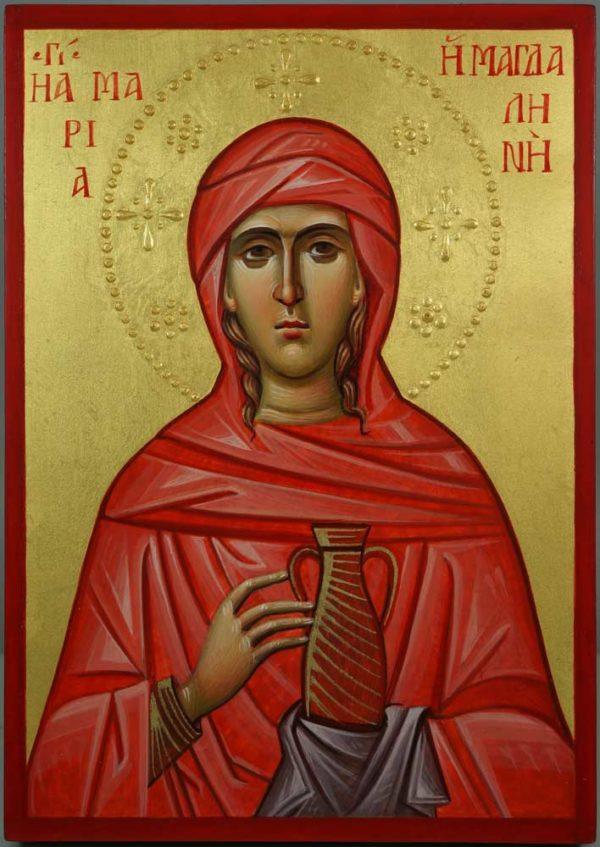
Fr. Dr. Andria Saria After the resurrection of Christ, the first appearance of the risen Christ was to Mary Magdalene. This is because this period, when the body of Christ was gloriously raised from the dead, was a time of mourning and sadness. So the first witness is a woman. The Gospel says: “Mary Magdalene went to the tomb early, while it was still dark, and saw the stone removed from the tomb” (John 20:1–3).
She went to see and understand what happened.
Mary Magdalene is mentioned first among the disciples. After this, the risen Christ first appears to Mary Magdalene. Mark the Evangelist writes directly: “Now when Jesus rose early on the first day of the week, He appeared first to Mary Magdalene” (Mark 16:9). This passage in Mark shows John’s testimony, where the dialogue between Mary and Christ happens: Mary Magdalene sees Jesus and does not recognize Him at first. Jesus asks: “Woman, why are you crying?
Who are you looking for? ” She thinks He is the gardener and says: “Sir, if you have taken Him away, tell me where you have put Him, and I will take Him. ” Jesus says to her: “Mary! ” She turns and calls Him: “Rabboni! ” (which means Teacher).
Jesus says to her: “Do not cling to Me, for I have not yet ascended to the Father. But go to My brothers and tell them: I am ascending to My Father and your Father, to My God and your God” (John 20:14–18). Mary Magdalene’s role is not only important as a witness. After Christ rose, she becomes the first to proclaim the resurrection. She is the first to see the risen Christ, and Christ entrusts her to announce it to the disciples with these words: “Go to My brothers and tell them: I am ascending to My Father and your Father, to My God and your God” (John 20:17).
Thus, Mary becomes the first messenger of the resurrection to the Church. Only Mary Magdalene sees Christ first and testifies alone. How did Mary understand and recognize the risen Christ at first? When Christ appeared, the disciples were confused, hiding, and afraid. They did not understand everything; only Mary Magdalene saw clearly, and she recognized the risen Christ.
She first learned about the resurrection of Christ, and then she told the disciples about it. On the first day of the week, she says: “I have seen the Lord,” sharing this joy. She did not know how to tell the disciples clearly at first. She only reported that she saw Him and that He had risen. Peter and John ran to the tomb to see, but they did not fully understand what Mary Magdalene meant.
At this time, it should be clear that “the disciples and the women will see, but they did not understand at first that Jesus had to rise. ” As they did not understand this, Mary Magdalene alone witnessed it. After Jesus rose from the dead, people did not understand clearly at first. They did not see Him themselves. Angels did not appear to everyone; only Mary Magdalene saw Him and understood that He had risen.
We need to pay attention to Mary Magdalene’s role. She saw the risen Christ first. She touched Him and believed. Later, Jesus showed Himself to the disciples. He said: “Touch Me and see.
A spirit does not have flesh and bones as you see I have” (Luke 24:39). Then Thomas touched Him and said: “My Lord and my God. ” (John 20:27). Not everyone believed at first. Only the people who followed Mary Magdalene understood what happened.
Why did Christ ask Mary Magdalene, “Do not hold on to Me”? He wanted her to understand that He had risen and that He would go to God the Father. She did not fully understand at first. But Jesus told her: “Go to My brothers and tell them: I am going to My Father and your Father, to My God and your God” (John 20:17). The words “Do not hold on to Me” show that Jesus was alive but no longer only human.
He had a new, risen life. Only Mary Magdalene saw Him first and received this message. Then she shared it with others. Mary Magdalene’s witness is very important. She helped the disciples believe.
She shared the love of Christ and showed others the resurrection. Because of her, everyone could learn about the risen Christ and believe in Him. After His resurrection, Jesus appeared to two followers on the road to Emmaus. They were walking from Jerusalem, about 10–12 kilometers away. The disciples did not understand what had happened.
Other followers were also confused. One of them was named Cleopas. They talked with Jesus, but they did not know that He was Jesus at first. They asked Him: “Are You the only visitor to Jerusalem, who does not know what has happened? ” (Luke 24:18).
Then Jesus explained to them, teaching from the Scriptures. They still did not understand at first. But when they shared the meal together, and He blessed the bread, they recognized Him (Luke 24:19–20). Before this, Cleopas and the other disciple did not know that Jesus had risen. This story helps us understand the role of witnesses after the resurrection.
Only after seeing Him and understanding the Scriptures did they realize that He had risen. Later, the risen Christ also appeared to some of His other followers. They told others that Jesus was alive. This gave them hope and courage. They shared the news with the disciples, saying that Jesus had appeared to them (Luke 24:22).
After this, the disciples became strong and confident witnesses. They could teach others about the risen Christ. These appearances were very important. The disciples saw Jesus in different ways, including breaking bread together, which showed them He was alive. Then Jesus appeared to many disciples together.
They saw Him and believed. Some doubted at first, like Thomas. But later, everyone understood that He had risen. Jesus showed them His hands and His side, proving He was really alive. Through these events, the disciples learned to believe and share the message of the resurrection.
They saw Jesus alive, touched Him, and learned from Him. They became strong witnesses for others, telling people about His life and resurrection. After His resurrection, Jesus appeared to His disciples. They were confused and did not understand that He had risen. After seeing Him, they became full of joy and believed.
Jesus taught His followers for a long time. He explained the Scriptures and showed them what was written about Him. At first, the disciples did not understand. But later, they learned that He was the Messiah, the Son of God. Jesus also gave His disciples a special mission.
He said: “Go and teach all nations, baptizing them in the name of the Father, the Son, and the Holy Spirit” (Matthew 28:19–20; Luke 10:5). He explained that they should teach and help others, showing God’s love. Jesus showed that faith is important. It is not only about seeing Him but also believing with the heart. Some disciples doubted at first, like Thomas.
But after seeing and touching Him, they believed. Jesus helped them understand that He had truly risen. After this, Jesus gave His disciples authority. He said, “Receive the Holy Spirit. If you forgive anyone’s sins, they are forgiven.
If you do not forgive, they are not forgiven” (John 20:22–23). This shows that Jesus gave the disciples the power to continue His work. Only after seeing Jesus did the disciples fully understand and receive their mission. They learned from Him and could teach others. They became strong witnesses of the resurrection, sharing the message of Christ with the world.
“Jesus granted the apostles authority to bind and loose on earth as it is in heaven (Mt. 16:19), and also granted similar authority to the broader group of disciples (Mt. 18:18). ” “After His resurrection, Christ appeared to the disciples in the room where they were gathered, and Thomas was not present at that time. Later, when the other disciples informed him, he expressed doubt and said: ‘Unless I see the mark of the nails in His hands and put my finger into them, I will not believe’ (Jn. 20:25).
Subsequently, Jesus appeared again and invited Thomas to touch His hands and side. Then Thomas responded, declaring: ‘My Lord and my God! ’ (Jn. 20:27). (… ) Thomas’s confession affirmed that whoever truly encounters the risen Christ, even if absent at the first appearance, will come to recognize Him and testify: ‘My Lord and my God’ (Jn. 20:28).
Thomas thus became the first to explicitly proclaim Jesus as the Lord. Christ, in granting authority to His apostles, also entrusted them with the responsibility of discerning and resolving conflicts among believers, especially in matters of truth, guidance, and spiritual oversight. This authority, however, was not absolute: it was exercised in humility and in the service of the community. As Scripture attests, ‘He who has received you has received Me’ (Mt. 10:40), and as John and Peter demonstrate, this authority is exercised relationally and responsibly.
John, for example, is depicted as loving and gentle, whereas Peter, though bold and zealous, sometimes errs and must be corrected. John demonstrates faithfulness through patient devotion; Peter, through courageous initiative. In this way, the Gospels present complementary models of apostolic responsibility. The narrative underscores that Jesus’ authority, bestowed upon the apostles, was both spiritual and practical: it encompassed the power to forgive sins, guide the community, and correct missteps—but always in alignment with Christ’s mission and with accountability to truth. The risen Lord appears to those gathered, reassures them, and empowers them, yet His recognition is not automatic; it requires faith, attentiveness, and relational discernment.
Hence, while all apostles were entrusted with authority, it is Peter who is frequently highlighted in the narratives for his decisive role, though the model is one of collective responsibility. In reflection, the text emphasizes that Christ’s gift of authority is relational, responsible, and transformative: it calls for discernment, humility, and fidelity, and it is fully realized in the community that bears witness to the risen Lord. ” “Christ entrusted the fullness of His authority to all the apostles; however, He exercised this in a particular way with Peter, entrusting him with a special leadership within the community. Unlike Peter’s authority, which was direct and visible, the authority of the other apostles was exercised more broadly and indirectly, as Christ guided and empowered them for the mission of the Church. Peter’s role was not simply about holding authority but about exemplifying responsibility, courage, and discernment.
For instance, when Jesus spoke of Peter’s future, He warned him about the cost of following Him: ‘When you were younger, you dressed yourself and went where you wanted; but when you are old, you will stretch out your hands, and someone else will dress you and lead you where you do not want to go’ (Jn. 21:18). These words highlighted the seriousness of apostolic service, showing that authority is inseparable from obedience, humility, and readiness to face suffering for the sake of the mission. Peter’s example demonstrates how authority is exercised relationally and responsibly: it is given for the service of others, not for personal glory. Even when Peter faltered or struggled with fear, Christ’s guidance and presence remained, affirming that genuine leadership requires both faith and perseverance. Through His resurrection, Christ appeared to the apostles, granting them the fullness of His authority and commissioning them to guide the Church in truth, justice, and spiritual care.
The initial appearances of the risen Lord were aimed at strengthening the apostles in their faith and preparing them for the task ahead. In the early Church, as the Acts of the Apostles describes, they exercised their authority and teaching with wisdom and courage, discerning the needs of the community and safeguarding the truth of the Gospel (Acts 1:3). Ultimately, the risen Christ appeared repeatedly to His apostles in Galilee, confirming their mission. Though some doubted or wondered about His presence, Christ reassured them and entrusted them with the responsibility to teach, guide, and baptize all nations, ensuring that His name would be proclaimed and that every act of mercy and authority would reflect His own. He commissioned them to carry the fullness of His message into the world: ‘Go therefore and make disciples of all nations, baptizing them in the name of the Father and of the Son and of the Holy Spirit, teaching them to observe all that I have commanded you’ (Mt.
28:19-20). Through this commission, Christ ensured that the apostles, beginning with Peter and extending to all, would serve as instruments of His authority and grace, entrusted with the care of His Church, the salvation of souls, and the guidance of the faithful in every generation. ” “The risen Lord entrusted His authority to His apostles and sent them into the world to proclaim His message to all people. He did not leave them to act on their own but empowered them with His Spirit and with visible signs of His presence and authority. Through this, the apostles were to carry out the mission of Christ in humility, courage, and fidelity, ensuring that His teaching would be faithfully transmitted.
Christ instructed the apostles to go beyond Jerusalem and to bear witness to all nations: ‘Go therefore and make disciples of all nations, baptizing them in the name of the Father and of the Son and of the Holy Spirit, teaching them to observe all that I have commanded you’ (Mt. 28:19-20). In this commission, He gave them authority not merely to instruct but to act as His representatives, bearing responsibility for the guidance, formation, and salvation of the faithful. When the apostles were sent forth and assembled, Christ reaffirmed their mission in Galilee, giving them the clarity and courage to act decisively. Though doubts and fears naturally arose, as they did among some of the disciples, Christ reassured them, calling them to obedience and trust: ‘Go from Jerusalem to all the ends of the earth.
’ This directive underscores that the apostles’ authority was both spiritual and practical; it was not for personal power or prestige but for the establishment of the Church and the extension of God’s kingdom. The mission from Jerusalem was foundational. Jerusalem symbolized the center of God’s covenant people, the place of the Temple, and the beginning of the apostles’ witness to both Jews and Gentiles. Yet Christ’s authority extended beyond the city: He commissioned the apostles to teach, heal, and guide communities everywhere, ensuring that the Gospel would be proclaimed with wisdom, courage, and love. As Scripture foretold, ‘From Zion shall go forth the law, and the word of the Lord from Jerusalem’ (Isa. 2:3).
The apostles, empowered by the Spirit, would exercise discernment, proclaim truth, and guide the Church faithfully across regions, nations, and cultures. Christ’s guidance emphasized that authority is relational and Spirit-led. The apostles would not act alone; they were to rely on the Spirit to teach, convict, and guide them in every situation (Lk. 12:12; Mt. 10:20; Jn. 14:16-17, 26; 15:26; 16:7, 13). As John demonstrates, authority is exercised with faithfulness and integrity, always in service of the mission rather than personal ambition.
Peter, too, exemplifies how authority requires courage and fidelity, even amid weakness and human error. The mission of the apostles was thus twofold: first, to bear witness to the risen Lord in Jerusalem, the center of covenantal life, and second, to extend that witness to Judea, Samaria, and the ends of the earth (Acts 1:8). Their work was to establish communities of faith, rooted in the teachings of Christ, and to ensure that every act of ministry—baptism, teaching, healing, and governance—reflected the authority and love of Christ. Ultimately, the apostles were called to be instruments of Christ’s authority, empowered by the Spirit, sent into the world to proclaim the kingdom of God, and responsible for nurturing the faithful in truth and holiness. As Isaiah prophesied, the Spirit of God would continually empower them: ‘I will pour out my Spirit upon your descendants’ (Isa. 44:3), guiding them in wisdom, courage, and steadfastness in fulfilling the mission entrusted to them.
” “And after He had said this, He was taken up, and a cloud received Him out of their sight” (Acts 1:9). This emphasizes the ascension of Christ, marking the transition from His earthly ministry to the apostles’ mission, empowered by the Spirit, and the beginning of their witness to the world. Asceticism is sometimes considered to have begun in the fourth century, but this is a mistaken view. From the early fourth century onward, one particular form of asceticism—eremitism, or the life of the hermit—became institutionalized and widespread. However, asceticism and eremitism are not the same.
Asceticism is a broader concept than eremitism. Asceticism, or spiritual practice, has a wide significance and has been characteristic of all Christians from the earliest period of Christian teaching and daily life. The Christians of the first centuries were as ascetic as those of the fourth and fifth centuries, though the forms of their ascetic practice were not identical. Whenever a Christian restrains himself according to divine commandments —renouncing worldly pleasures, resisting earthly trials and temptations, and combating sin—this constitutes asceticism and ascetical labor. The very term asceticism carries a rich meaning: in Greek, askēsis (ἀσκησις) literally signifies training, exercise, or preparation.
It is also possible that the term is related to the Greek tōskeuōn, meaning “vessel,” suggesting that the body is being prepared as a sacred vessel. In any case, the essence of asceticism involves training—preparing one’s body and nature to become a vessel for God, a vessel for the Holy Spirit. Though asceticism literally refers to training and discipline, it also signifies virtue, readiness, and spiritual formation. The person trains his own nature to become a sacred vessel, and this is the core of ascetic practice. Ascetic labor is derived from the example of Christ and the apostles, who laid its foundation.
Over time, it took on outward forms, and by the fourth century, eremitic asceticism— withdrawal from society—was fully developed. Hermitic life, while diverse internally, shares the general character of separating oneself from worldly distractions in pursuit of spiritual perfection. Before discussing these internal variations, it is important to note why eremitism became so widespread in the early fourth century and why this form of asceticism was not prominent earlier. Until the fourth century, the first three centuries of Christianity in the Roman Empire were essentially marked by persecution and martyrdom. Christians suffered extreme oppression; all forms of coercion were employed against them, primarily physical violence, and countless Christians were martyred under various emperors.
Equally dangerous, however, was verbal persecution: slander and propaganda against Christians were rampant. As second-century apologists report in detail, accusations circulated about Christian lives, and three main charges were typically leveled against them. First, Christians were called “atheoi”—“atheists. ” To this, the Athenian apologist Athenagoras replied that indeed they were “atheists” regarding the powerless idols, but they believed in the one great Lord, the Almighty Creator of heaven and earth. Nevertheless, opponents of Christianity spread rumors of impiety before the emperors.
In the Roman Empire, as Athenagoras and other apologists argued, impiety was considered the gravest misfortune and the most serious distortion of human consciousness and soul. Christians were persecuted for this perceived impiety, both through physical and verbal attacks. There was also an extremely serious slander against Christians: a widespread belief that they ate human flesh. Opponents of Christianity “proved” this accusation by taking liturgical words out of context, using Christ’s own words: “Take and eat; this is my body, broken for you for the forgiveness of sins” and, regarding the blood: “This is my blood of the new covenant, shed for you and for many for the forgiveness of sins. ” The first phrase—“Take and eat; this is my body, broken for you for the forgiveness of sins”—was misrepresented as suggesting literal consumption of human flesh.
In response to this grave accusation, Athenagoras addressed the emperors: if any of this were true, then Christians should not merely be persecuted; they should be completely exterminated so that no trace of them remained. But if all this is slander, what kind of punishment should befall those who make such false accusations? Equally terrible was the accusation that Christians engaged in incest, bloodshed, and permissiveness in every area of life, with the supposed proof being Paul’s statement: “You are all one in Christ Jesus; there is neither male nor female. ” This passage, of course, has a completely different meaning. Christian persecution was intense.
During these times, many Christians sought to avoid persecution by hiding in remote places. This was especially true toward the end of the 40s and into the early 50s, during the persecutions under Decius, when many Christians avoided the swords of their persecutors and took refuge in inaccessible locations. Once persecution ended, many of these Christians had become so accustomed to solitude and withdrawal that they did not return to ordinary life but continued their spiritual labors. From a historical perspective, many scholars suggest that one of the reasons for the rise of eremitism was precisely this habit of withdrawal: Christians who had survived persecution had settled in remote locations and continued to live apart from society. Of course, this alone does not fully explain the phenomenon, though it may have contributed.
Otherwise, eremitism would have begun in the first or second century, since intense persecutions also occurred then, and Christians would have similarly avoided danger. However, the primary cause is to be sought in spiritual motivation. The first three centuries were characterized by martyrdom—not only because Christians were persecuted and forcibly made victims of their oppressors, but also because many Christians themselves desired a martyr’s death. The martyr’s crown is the highest crown, uniting a person with Christ, who died on the cross for the truth. One who suffers martyrdom for Christ is truly crucified, buried, and resurrected with the Savior.
Many Christians actively sought martyrdom. For example, Saint Ignatius of Antioch so longed for and strove toward martyrdom that those who loved him were urged not to display excessive affection, even though love is generally a good thing. Ignatius, who foresaw the suffering awaiting him in a few days—being torn apart by wild beasts—already spiritually anticipated his martyrdom. He no longer focused on worldly matters, and any external demonstration of love could distract him from the supreme good he sought. He even says: “I desire martyrdom, but I do not know if I am worthy.
” He recalls Christ, saying that his own desire for martyrdom is united with Christ’s suffering. Many Christians similarly longed for martyrdom. Saint Shushanik declares: “I will go to a sincere death. ”Origen, when his father was imprisoned, sent a letter encouraging him to embrace martyrdom. Origen himself was so fervent in his desire for martyrdom that, if not prevented by his mother, he would have undoubtedly sacrificed himself alongside his father.
These examples demonstrate clearly that among early Christians there existed a profound, irresistible spiritual drive for co-martyrdom with Christ, a desire to prove their love for Him even through physical suffering. Once the era of persecution in Rome ended, Christianity was first tolerated, then gradually accepted, and finally became a recognized religion. At that point, Christians were no longer persecuted for their faith. However, the sacred desire for co-martyrdom with the Savior burned in the heart of every Christian. Accordingly, because external persecutors had effectively been removed, Christians turned to confronting the sins of their own souls.
They undertook the struggle against their own sinful tendencies and decided for themselves how to combat sin. Consequently, they withdrew from the world so that, in times of extreme difficulty, they could achieve co-martyrdom with the Savior through their spiritual labors. Eremitism is essentially the same as martyrdom, except that it is carried out spiritually, through inner struggle, without the use of external force. This spiritual state is a continuation of the earlier martyrdoms of the first through third centuries, which were expressed through physical sacrifice. The true foundation of eremitism was precisely this: the martyrial desire of the Christian needed a form in which it could be fulfilled spiritually.
Eremitic asceticism therefore finds its model in Anthony the Great, although there were earlier hermits, such as Paul of Thebes, who lived in isolation and died at the age of 113, and whom Anthony himself buried. Nonetheless, Anthony is considered the principal founder and the initiator of monastic life. His life became widely known, and he had countless disciples. Paul of Thebes, by contrast, had no disciples. Anthony became the beacon to which countless Christians of subsequent generations turned, and even today many follow the path he pioneered.
I will not go into detailed discussion here, nor into his seven most important epistles that have come down to us. The key point is that monastic life and ascetic literature were firmly established at this time. While ascetic practices existed before, the distinctly ascetic literary genre—the ecclesiastical ascetic literature— was formed in the fourth century as eremitic, i. e. , virtue-centered theology.
This includes Anthony’s epistles, the records of his successor Ammonas, the epistles of other great desert fathers, as well as the establishment of the first monastic typicon by Pachomius the Great. The works of Macarius of Alexandria and Macarius of Egypt, especially the latter’s spiritual teachings and discourses, are also key sources. Likewise, Saint Horsiusius and Saint Theodore, as well as Evagrius Ponticus—who unfortunately went astray in certain dogmatic matters, particularly the Origenist error regarding the preexistence of souls and was therefore anathematized—played foundational roles. Nevertheless, the Church preserved his writings and the positive impact of his work was not lost. His labors have reached us in edited form.
For example, John Climacus’ book The Ladder is written according to the form of line-based writing (or columnar writing) developed by Evagrius. A significant portion of ascetic literature consists of paterika and materika, which describe the lives and teachings of desert fathers and mothers. This includes texts related to Palladius, Theodoret of Cyrrhus, and John Moschus. Many of these texts are anonymous, sometimes organized alphabetically or by assigned names. Let us now turn to the spiritual dimension: what is the ultimate phenomenon of monasticism—faith?
Spiritual knowledge of the world differs fundamentally from scientific knowledge. Classically, “knowledge” means “study” or “understanding. ” When a person seeks to know the world, three essential components are involved: first, the subject, “I”; second, the object, that which is to be studied and known; and third, the means through which one begins this study. This can include the body, hands, instruments, language, mathematical models, microscopes, etc. Everyone’s idea is ultimately the same: through these means, I grasp the object of study.
However, when it comes to the spiritual, the matter is entirely different. First, what is to be known? God? According to the Holy Fathers, God is known through our actions. There is the concept of “energy” or “divine grace,” which affects human existence independently of us.
When we live according to God and our spiritual vessel is ready to receive divine grace, our soul is illuminated and shines with divine light. When we wish to know God, we must first ask: where and how is it possible to perceive and experience God’s action? The Gospel tells us that the kingdom of heaven is within us, not outside. Here, the subject and object are clear: the place of discovery is within me. Although this is not of my own making, it is within me —so its discovery occurs within.
As for the discovery itself, I must be the one who discovers. According to ecclesiastical teaching, a person must first transform themselves; the change begins internally, not externally. Now let us address an important distinction: there is a significant difference between Christian thought and intellectual thought. Consider the understanding of the word “truth. ” In classical antiquity and medieval philosophy, “truth” meant reality itself, not our idea of God, nor our idea of reality.
Truth simply was reality. Christ Himself says: “I am the way, the truth, and the life. ” Later, however, in European thought, a shift occurred: truth moved from an ontological understanding to an epistemological one, meaning truth became about our conception or representation of reality. People no longer sought to receive truth, but rather to judge and evaluate it. Now, when Christians speak of coming to know the true way and true faith, what is this way?
Spiritual knowledge is not merely intellectual; it is not about formulating ideas or concepts. In English, “to know” often implies connection, union, or relation. For instance, in the Bible, when it says Adam “knew” Eve, it implies a real connection, a bodily union. Likewise, when Scripture speaks of knowing God, there is a difference between knowing about God and knowing God Himself. One may have heard about Father Andria; another may know him personally.
The difference is substantial. Similarly, we must move from knowledge about God to knowledge of God Himself. This is the true way of connecting with God. In this process, the word asceticism occupies a central place in Orthodox Christian life. Spiritual life is structured somewhat like a frog’s vision: when a frog is stationary, it sees nothing but moving objects.
Only movement allows it to perceive trees, stones, and other things around it. Likewise, a person who remains stationary and does not develop may feel that nothing happens; life seems monotonous and repetitive, even tedious. At such times, the distinction between good and evil appears fabricated. There is a simple rule in life: you cannot receive more from God until you fulfill what you already know. As the Gospel says, “To him who has, more will be given.
” Self-knowledge is the path of asceticism. God is everywhere, but the realization of this must occur within you. When a person has purity in the heart, they see everything around them as holy.