
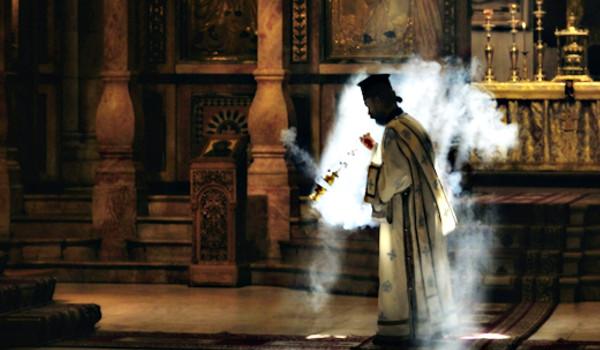
The ministry of the shepherd of Christ’s Church, the priest of the Most High God, is truly righteous, holy, and full of responsibility. In a sense, it is a unique service, set apart from all ordinary human roles.
God Himself willed that the transmission and protection of His divine grace, as well as the preaching of His covenant, be entrusted to the tribe of Levi, whom He chose. The reason for giving them such a special role was, without doubt, that the Levites did not take part in the worship of the golden calf at Mount Sinai. From this tribe came Moses and Aaron, the great leaders of the people, who carefully guarded moral purity and faithfully carried out God’s commandments. God Himself commanded Moses to bring Aaron and his sons before the Tabernacle and consecrate them for priestly service: Bring near to you Aaron your brother, and his sons with him, from among the people of Israel, to serve Me as priests (Exodus 28:1).
In this way, the hierarchical priesthood of the Old Testament begins with the priesthood of Aaron. However, this structure was not yet in the full form that later appeared in the Church of the New Testament. It had an initial and symbolic character, pointing forward to what was to come. The selection of Aaron and his sons for this great priestly ministry was followed by their special consecration through sacred actions: washing, being clothed in priestly garments, anointing with oil, the sprinkling of sacrificial blood, and remaining for seven days at the entrance of the Tabernacle.
They began to exercise their priestly ministry in a solemn way only on the eighth day (Leviticus 8:2–36; 9:1–24).
The establishment of a hierarchical order by God was connected to the reality that, because of sin, the people of Israel were no longer able to speak directly with God: You speak to us, and we will listen; but do not let God speak to us, lest we die (Exodus 20:19). From these words, it is clear that the people themselves came to understand the need for a special mediator—someone who would stand between God and them. In the Old Testament, the threefold priesthood, Levites, priests, and the high priest, had different responsibilities. Only the high priest could enter the Holy of Holies.
The priests carried out their ministry in the sanctuary, while the Levites, who held the lower rank, served in the courtyard of the Tabernacle. The Lord Himself defined the duties of the priesthood and the high priesthood: You shall attend to your priesthood for everything concerning the altar and that which is behind the veil (Numbers 18:7). Concerning the service of the Levites, the Lord said to Aaron: Bring your brothers also, the tribe of Levi… that they may join you and serve you… they shall keep guard over you and over the whole tent… but they shall not come near the vessels of the sanctuary or the altar, lest they die, both they and you (Numbers 18:2–3). In the Old Testament, the priesthood had one main purpose: to cleanse the people from bodily and spiritual impurity and to prepare them to become a people pleasing to God. Without exaggeration, it can be said that the role of the Old Testament priesthood in forming and guiding the entire nation was irreplaceable.
The establishment of the Church hierarchy is clearly and firmly confirmed in the New Testament. The Lord Jesus Christ, the “High Priest according to the order of Melchizedek,” Himself appointed in His Church a special group of people who were given the responsibility of teaching (Matthew 28:19–20; Acts 1:8), guiding the spiritual life of Christians, and exercising the authority to bind and loose sins (John 20:21–23). From Holy Scripture we know that Jesus Christ personally chose twelve from among His disciples and called them apostles (Luke 6:13). He said to them: You did not choose Me, but I chose you and appointed you that you should go and bear fruit(John 15:16). Christ the Savior gave this command and authority only to His chosen disciples, entrusting them with the teaching and life of the faithful.
He passed this authority to the holy apostles just as He had received it from the Father: As the Father has sent Me, I also send you (John 20:21). Later, He also appointed seventy others for ministry (Luke 10:1). After the Resurrection, Christ granted the apostles the grace of the Holy Spirit, saying: Receive the Holy Spirit. If you forgive the sins of any, they are forgiven; if you retain them, they are retained(John 20:22–23). In addition to teaching, celebrating the sacred mysteries, and providing pastoral guidance, the holy apostles were also given the authority to pass this ministry continuously to their successors.
The clergy continue the work of the apostles. Through the canonical sacrament of ordination (cheirotonia), they share in the threefold ministry of Christ, High Priest, Prophet, and King and serve as representatives of our Church’s supreme High Priest, Prophet, and King, Jesus Christ. The expression of this threefold dignity is carried out through three types of ministry of the clergy: liturgical, teaching (didactic), and pastoral–administrative. We recognize three ranks of the priesthood: deacon, priest, and bishop. Ordination for all three ranks takes place in the altar, before the ambo, during the Divine Eucharist, because the mystery of priesthood is firmly connected to the Eucharist.
More specifically:
- The ordination of a deacon takes place shortly before the Lord’s Prayer, after the exclamation: “And the mercies of the great God…”
- The ordination of a priest takes place after the Great Entrance.
- The ordination of a bishop takes place before the reading of the Apostle.
In ancient times, the parish was centered around the bishop, because he was its head, together with the priests and deacons. A priest could celebrate the Divine Eucharist only with the bishop’s permission. From the second half of the second century, however, this bishop-centered structure developed into multiple parishes, where the Eucharist was celebrated with the bishop’s blessing.
According to Ignatius of Antioch, the bishop is “the image and likeness of God the Father” (see Letter to the Trallians 3. 1; Letter to the Magnesians 6. 1). The Apostle Paul the Apostle writes to Titus concerning episcopal authority: For this reason I left you in Crete, that you should set in order what remains, and appoint elders in every city (Titus 1:5). He also warns: Do not lay hands on anyone hastily, nor share in other people’s sins; keep yourself pure (1 Timothy 5:22).
The 14th canon of the Fifth–Sixth Ecumenical Council states that a priest should not be ordained before the age of thirty, even if he is worthy, following the example of our Lord Jesus Christ, who began His teaching at that age. Likewise, a deacon should not be ordained before the age of twenty-five, and a deaconess not before forty. Another canon declares that if anyone is ordained to the priesthood before these appointed ages, he is to be removed. As Scripture also teaches, one should not be newly planted, lest he become proud and fall into judgment and the snare of the devil (cf. Acts of the Apostles; Apostolic Canons).
A candidate for the clergy should not have a physical condition that would prevent him from fulfilling priestly duties. For example, the canons state that those who are deaf or blind should not be ordained as bishops, not because they are considered sinful, but so that they may not be hindered in carrying out the works of the Church. Likewise, one who is possessed should not be ordained (Apostolic Canons 78–79). Also, one who has mutilated himself is not permitted to remain in the priesthood: “If a cleric has castrated himself, let him be deposed, for he is a destroyer of his own life” (Apostolic Canon 23). A good reputation among outsiders is also required (1 Timothy 3:2–7; Canon 12 of Laodicea).
The candidate must not be a shameful person: not a thief, not deceitful, not greedy for money, not one who breaks oaths, and not one who has committed murder, whether intentionally or unintentionally. As the canons say, if someone kills another—even unintentionally in a conflict—he is to be removed from the clergy; and if he is a layperson, he is to be excluded from communion (Apostolic Canon 65). A priest receives his rights and responsibilities according to his rank, within the parish entrusted to him. However, he does not perform ordinations himself, nor does he appoint clergy (except for an abbot, who may tonsure a monk). A priest also does not consecrate churches, perform the rite of dedication (enkainia), or consecrate the antimension.
He cannot tonsure a monk, and he may not hear confessions without the special blessing of his bishop.
The Three Ranks of the Hierarchy
The Church distinguishes three ranks within the ecclesiastical hierarchy. Entry into any of these ranks cannot be achieved by personal desire alone. It is granted by the Church, and each rank is conferred through God’s blessing by ordination from a bishop.
The presence of all three ranks of priesthood is essential for the life of the Church. However, a small community may be allowed to have only one or two clergy (for example, a priest alone, a priest with a deacon, or two priests). Yet in the whole Church, even at the local level, the fullness of the hierarchy is necessary. A disciple of the apostles, Ignatius of Antioch, shows how the early Church understood this in his letters. He writes: “It is necessary… that you do nothing without the bishop. Likewise, be subject to the presbyters as to the apostles of Jesus Christ… and respect the deacons as the commandment of Jesus Christ… Without them there is no Church.
” Bishops hold the highest rank in the hierarchy. Just as life cannot exist without order and leadership, it is natural that there should be a highest rank above presbyters and deacons. This is also confirmed by early Church writings. As Ignatius says: “Where the bishop is, there let the people be, just as where Jesus Christ is, there is the Catholic Church. ”
Similarly, Tertullian states that the Church cannot exist without bishops. Among bishops, some may have a higher position of honor, but not a higher degree of grace or priesthood. The same was true among the apostles. Some were especially honored and known as “pillars” (Galatians 2:9), yet all were equal in their apostolic dignity.
The Apostle Paul the Apostle emphasizes this equality when he says: “I am not at all inferior to the most eminent apostles” (2 Corinthians 11:5; 12:11), and yet he adds humbly, “though I am nothing” (2 Corinthians 12:11).
Relationships among the apostles were based on this principle of equality.
Speaking about his visit to Jerusalem to meet the well-known apostles—James, Peter, and John, Paul explains that he went “by revelation” (Galatians 2:2), meaning he relied on the shared, conciliar mind of the apostles, not on the personal opinion of any one individual. He also writes: “God shows no partiality” (Galatians 2:6). Referring to a specific event, Paul says: “When Peter came to Antioch, I opposed him to his face, because he stood condemned” (Galatians 2:11). This shows that even among apostles there was accountability, especially concerning important issues like the acceptance of Gentile Christians. This principle of equality in grace and apostolic authority has remained in the Church among the successors of the apostles, the bishops.
Receiving the priesthood does not automatically change a person inwardly. The balance of good and evil within him remains as before. Therefore, a priest must struggle against his own weaknesses just as every member of his flock does. There are two kinds of hierarchy. The first is the ecclesiastical hierarchy, through which a person receives divine grace to perform the sacraments and sacred rites.
However, this grace belongs not to the individual as such, but to the office. It is given, so to speak, as a trust for fulfilling a sacred mission. The second is the spiritual hierarchy, which depends on a person’s personal effort and inner life. According to Gregory of Nazianzus, speaking about the priesthood: “I have seen a river flowing from a rock into a valley. The stones it touched remained stones, but the flowers and grass absorbed the water and came to life.
” In the same way, the soul of a priest burdened with unrepented sins can become like a lifeless stone, while the souls of those standing in the church receive the living water of divine grace. A priest is called “father” because he participates in the spiritual birth of a Christian, from baptism to burial. He is also called a shepherd (pastor), because he leads his flock along the path of the Gospel commandments. But if he teaches something contrary to the Church, he loses the authority to guide, and his words become empty. Thus, the priest has a threefold ministry before God and the people.
In liturgical service, he is a symbol of Jesus Christ, that is, through the priest, Christ Himself acts in the divine services. At times, the priest may also represent John the Baptist or the apostles. The second aspect of his ministry is the preaching of the Word of God. This depends not only on divine grace but also on the priest’s personal qualities, knowledge of Holy Scripture, and spiritual maturity. Grace develops these natural gifts and has a special effect on the hearts of the listeners.
For this reason, the preaching of a priest has greater power than that of a layperson, even if they are equal in knowledge and intelligence. Finally, the priest is the guide of his flock on the path of salvation. As a teacher of moral life, he must himself know well the path on which he leads others. Of these three forms of service, the first, the liturgical ministry, is absolutely essential and must always be fulfilled.
The second aspect of ministry, preaching is also necessary, but it is not always fruitful. The third, pastoral leadership, is desirable, yet often difficult to achieve. The first form of service, the liturgical ministry, is fully given to the priest. The second depends on his gifts and abilities, while the third depends on his personal character. Grace can be compared to a burning fire that warms the house of the soul.
But if one is careless, this same fire can become destructive and consume everything. According to Macarius of Alexandria, it was revealed that in the deepest depths of hell it is not only robbers, murderers, magicians, or idol worshipers who suffer, but also those priests who lived without order, had no repentance, and yet dared to celebrate the Divine Liturgy. How should the faithful respond if they see an unworthy priest, whose behavior may even be seriously immoral? They should act as a child toward a sinful father: honor him because of God’s commandment, but not imitate him. What do the outward signs of respect for a priest mean, such as kissing his hand or receiving his blessing?
They mean that the priest is a symbol of Jesus Christ, and through him Christ Himself blesses you. Therefore, the honor is given not to the person as such, but to God. In the same way, when one honors an ambassador of a country, the honor is not directed only to the individual, but to the state he represents. For this reason, a believer may limit personal contact with an immoral priest in order to avoid spiritual harm, yet still show him proper respect for Christ’s sake, since the grace given in ordination remains. We also see an example in Scripture: Cain offered a sacrifice to God, but because of his grave sin, God did not accept either him or his offering, while He accepted the offering of Abel.
Finally, Symeon the New Theologian teaches that one should always seek a true spiritual guide. Throughout life, a person should look for someone who can truly nourish and guide the soul.