
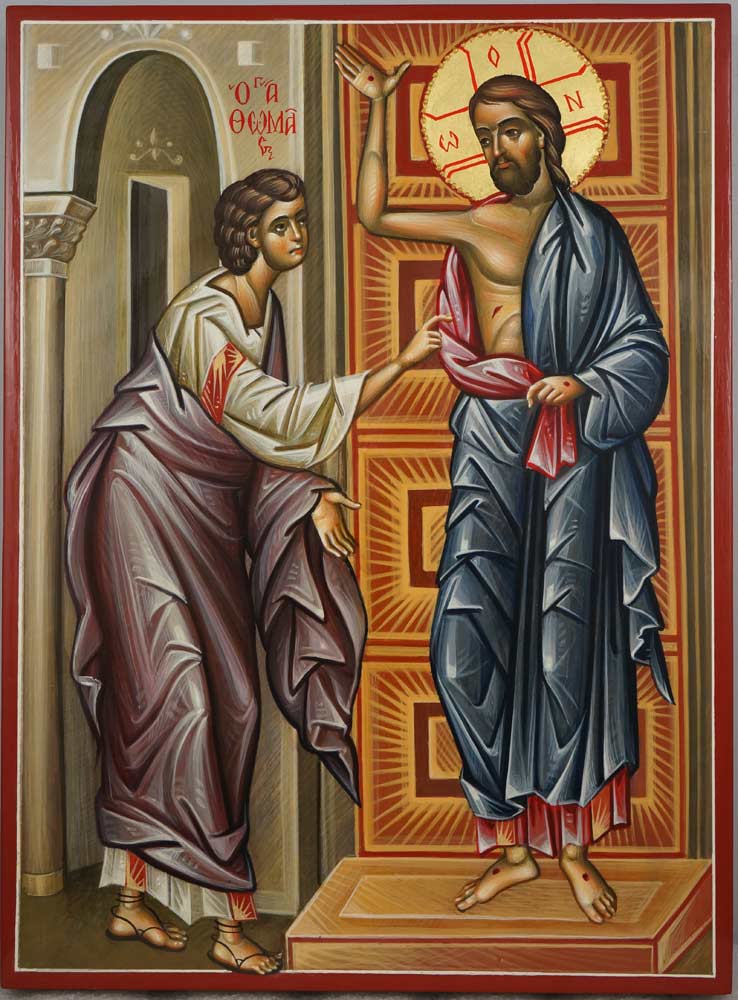
In the name of the Father, and of the Son, and of the Holy Spirit! The episode of the Apostle Thomas makes us reflect on many things. On one hand, it reminds a person of oneself. I remember there was a time when I was reading many theological books and began to doubt, is all of this really true? How is it that all these stories resemble one another so closely?
I found myself asking this especially when reading about the holy martyrs and the lives of the saints. But I did not ask the same kind of question in other cases: why are human beings so similar to one another when they feel hunger or when they wash their hands and face? That seems simple, does it not? There is only one way to satisfy hunger, we must eat. The path to holiness is similar, one must struggle and labor in order to become holy, and this path leads to a single end.
This is something I did not understand at the time. To have questions, even doubts, is not evil. Doubt is born in the mind. We are not robots programmed to think in one fixed way, we are free beings, and we have the right to question. This is not a rejection of God; rather, it is a path toward seeking God rightly.
The story of the Apostle Thomas is not merely about doubt, it is about the mystery of faith, the struggle of the human heart, and the victory of love over hesitation. Despite his strong and outspoken doubt, Thomas remains among the apostles. He is not cast out, nor rejected. The other disciples do not distance themselves from him, even though he openly questions the Resurrection. Why?
Because they see something deeper in him. Thomas is not an unbeliever, he is a man with a strong, persistent mind, a mind that seeks certainty where faith alone seems to be required. His doubt is not cold indifference; it is born of love. He had listened attentively, perhaps even with tears, to the accounts of Christ’s suffering, His crucifixion, the piercing of His side. These events left a deep and unerasable mark on his soul.
And precisely because he loved so deeply, he struggled to accept such overwhelming joy: that Christ is risen. So the apostles wait. They do not argue with him. They do not condemn him. They trust that Christ Himself will reveal the truth to Thomas.
And indeed, on that Sunday, as the disciples are gathered together, the Lord appears among them and says: “Peace be with you. ” Then He turns to Thomas, not with anger, not with reproach, but with compassion: “Put your finger here… and do not be unbelieving, but believing. ” In this moment, Christ reveals something profound: He had heard Thomas’ words even when He was not visibly present. As He Himself had said, “Where two or three are gathered in My name, there am I among them. ” Christ is not only all knowing, He is personally present, especially among those gathered in love and in His name.
Thomas’ doubt, then, is transformed. Not by argument, but by encounter. Not by logic, but by presence. And from the depth of his soul bursts forth the greatest confession: “My Lord and my God! ” No one had spoken so fully before.
Others had called Him Messiah, Son of God, but Thomas proclaims both His lordship and His divinity with complete clarity. The very one who doubted most deeply now confesses most completely. This is the paradox of faith: sometimes the deepest doubt becomes the doorway to the strongest confession. Yet Christ adds something more: “Because you have seen Me, you have believed. Blessed are those who have not seen and yet have believed.
” Here, brothers and sisters, Christ speaks about us. We who have not seen, yet believe, we are called blessed. Not because our faith is easier, but because it is freer. Faith that depends only on sight is no longer faith, it becomes necessity. But true faith is born from love, trust, and openness of heart.
Thomas teaches us that doubt itself is not sin. What matters is what we do with it. Doubt can become a wall, or it can become a path. If it is joined with humility, with longing, with love, it leads us to Christ. Brothers and sisters, today’s feast is called Antipascha, which means “instead of Pascha,” because this day is the first Sunday following the Paschal celebration, and it carries within it the light and radiance of Christ’s Resurrection.
We greet one another with the most joyful words for a Christian: “Christ is Risen! , Truly, He is Risen! ” If in these days even the fiercest enemy were to meet us and greet us with the news of the Risen Christ, our hearts would tremble, we would no longer see in him an enemy, but a friend. Even if not a human, but a wild beast could speak to us in a human voice and say, “Christ is Risen! ”, it seems that we would embrace it, kiss its face, and respond to it as to a brother: “Truly, Christ is Risen!
” With the birth of Christ, the history of humanity was divided into two periods. A new reckoning of time began from the day of the Nativity of Christ. With the Resurrection of Christ, sacred history was likewise divided into two periods, the old, when sin, hell, and death reigned in the world; and the new, when sin was conquered, and death and hell were overthrown, their power cast down. Therefore, the words “Christ is Risen! ” sound as a triumphant hymn over death, a hymn of both the Heavenly and the earthly Church.
In these two words is contained the highest meaning and the fulfillment of the promises of both the Old and the New Covenants. What does the word “Pascha” mean? Translated from the Semitic languages, it means “to pass over. ” In the Old Testament, Pascha was the feast commemorating the Exodus of the Jews from Egypt. Yet in the events of the Old Testament, we often see images, “shadows”, of what was to be fulfilled in the New Covenant.
Theologians say that the New Testament is hidden in the Old, and the Old Testament is revealed in the New. There are prophecies expressed in words, but also prophecies expressed through actions and events. For example, Jeremiah placed a yoke upon his neck to show the people of Jerusalem that they would become servants of the king of Babylon. In the same way, the feast of the Old Testament Pascha already contained within it the prophecy of the Pascha of Christ. A small pastoral tribe, consisting of the children and household of Jacob, moved to Egypt because of a severe famine in Palestine.
The Pharaoh who ruled there gave them fertile land. But after some time, a change of dynasty took place. The new Pharaoh began to oppress the Israelites: he burdened them with hard labor, forced them to make bricks from clay and straw, and finally ordered that all male infants born to them be killed. What does this mean in a spiritual and prophetic sense? Egypt, in the ancient world, was a center of Sin.
There, the most terrible pagan rituals and sacrifices were performed. Therefore, in a spiritual sense, Egypt symbolizes hell. To the south lay vast deserts, lifeless spaces where the eye could see only endless الرمال and stones, broken rocks shaped by the wind into strange forms. No bird flew there, no animal passed between the stones. Everywhere there was emptiness and death.
Thus, Egypt also represents the kingdom of death. At first, the Egyptians received the Jews kindly, but later they enslaved them and subjected them to the harshest suffering. In the same way, the demon first deceives a person with dreams of happiness and joy, but then gives only bitterness, heaviness of spirit, and despair, for the demon itself is the spirit of despondency. The prophet Moses decided to lead the Israelites out of Egypt. He came to Pharaoh, but Pharaoh answered proudly: “I do not know your God, and I will not let your people go” (Exodus 5:2).
Thus, before the coming of Christ, neither the prophets nor even the heavenly powers could free humanity from the dominion of death and hell. The Lord sent ten plagues upon Egypt. The last of them was the killing of the firstborn by the destroying angel. The Lord said to Moses that the Israelites should mark the doors of their houses with blood so that the angel would pass over them. What do these mysterious words mean?
Did the angel lack knowledge? Did he need visible signs to distinguish whom to spare and whom to strike? No, brothers and sisters. Here we see a prophecy of the salvation of humanity through Christ. This blood was the blood of sacrifice.
According to the Holy Fathers, two lines were marked on the doors, one vertical and one horizontal, forming the sign of the Cross. Thus, the meaning of “Pascha” is that the angel passed over those houses on which he saw the sign of the Cross in blood. In the same way, through the blood shed on the Cross, the blood of Christ the Savior, Christians are delivered from death. Thus, brothers and sisters, in the Old Testament, through images and “shadows”, we already perceive the mysteries of the New Testament. Moses spoke of a land flowing with milk and honey.
In the Old Testament Passover, people were commanded to eat unleavened bread as a sign of haste. Now, however, we partake of the Pascha prepared with milk and honey, as a sign that the Kingdom of Heaven is open to us. Today, some church distribute the artos, the blessed bread. It symbolizes the manna of the Old Testament, the heavenly bread that fed Israel in the wilderness. It also recalls how Christ shared meals with His disciples.
After His Ascension, the apostles would place bread on the table where Christ had sat, as a sign of His invisible presence. After the meal, they would lift it and say, “Jesus, help us,” and then share it among themselves. There is also the custom of exchanging red eggs at Pascha. In the visible world, we see many images of the Resurrection: a plant that blooms after winter, a caterpillar that becomes a butterfly, a chick emerging from an egg that seemed lifeless. The red color signifies that we are redeemed by the blood of Christ.
Yes, brothers and sisters, the Pascha of Christ is the greatest feast, the victory over the hell and death. You may ask, if the demon is defeated, why do we still feel his temptations? Before Christ, the demon ruled humanity like a tyrant. Now his power is broken, he can only tempt, deceive, and lie. Now death is no longer a terrifying abyss, but a peaceful rest, a gentle sleep until the Resurrection.
Thus, the Lord has conquered hell. And yet, some still fall into hell. Why is this? Because before Christ’s Resurrection, even the righteous descended into the underworld. But now, repentant sinners inherit the Kingdom of Heaven.
Christ is Risen! Truly, He is Risen! Amen.