
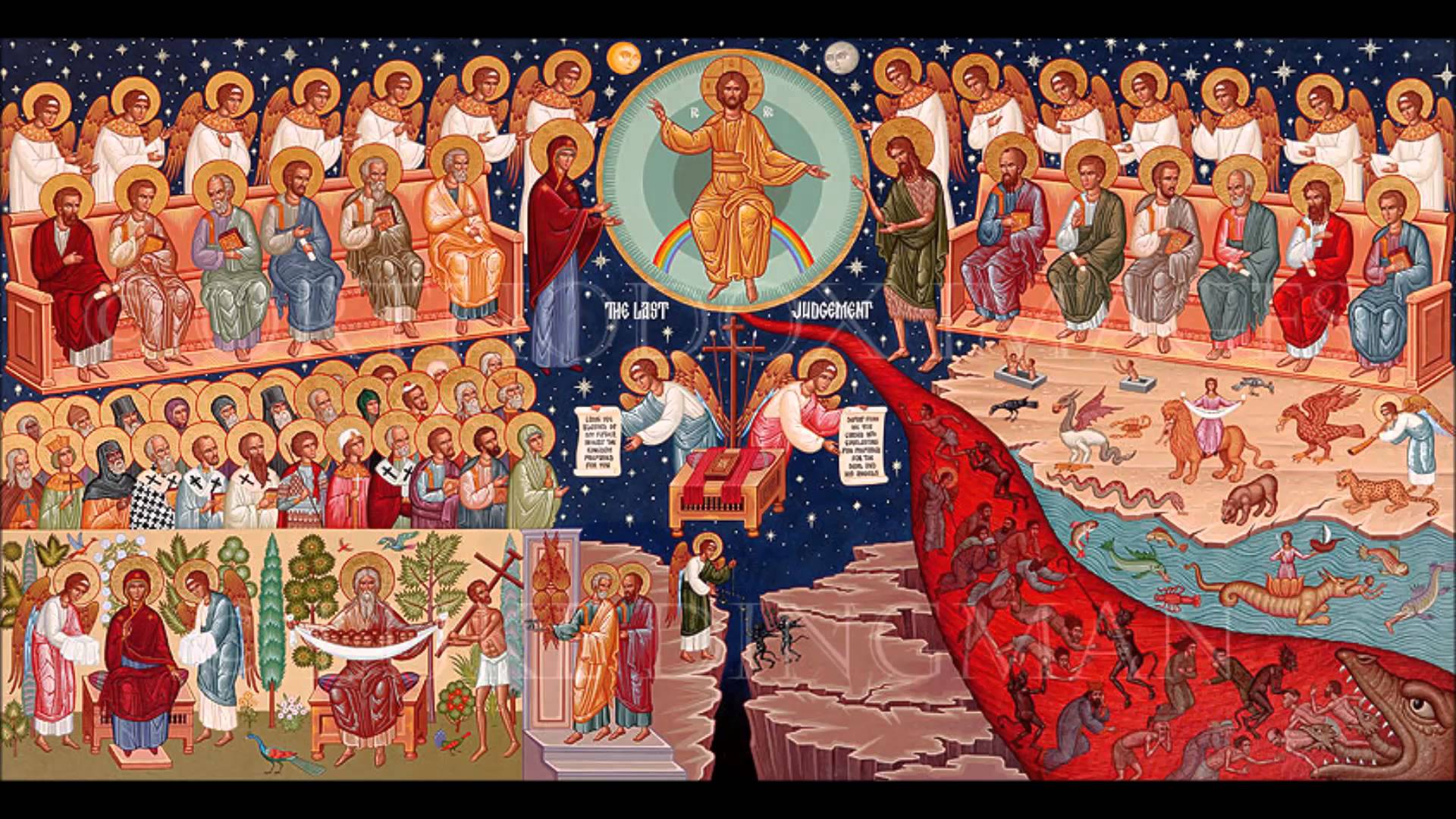
– Fr. Dr. Andria Saria In the name of the Father, and of the Son, and of the Holy Spirit. One God, Amen. Today is Sunday, the Day of the Remembrance of the Last Judgment. How should we approach this day?
The Church stands as our guide, our teacher, preparing us in advance for the examination of our souls, just as a wise instructor equips a student before a crucial exam—not so the student fails, but so they may pass faithfully and honorably. In the same way, the Church reveals to us what we must do to prepare for the spiritual accounting before God. This Sunday is called Meatfare Sunday because after this day the Church asks us to begin a partial fast and stop eating meat. This is part of our preparation for Great Lent. The Church slowly leads us into this time of spiritual struggle because she knows that we are weak and need time to prepare.
On the Saturday before, the Church prays for all the departed, remembering those who died with hope in the resurrection and eternal life. Christianity is a religion of love. Christ did not teach only about personal salvation; He gave a new commandment: “Love one another. ” Love is the foundation of the Church. Sin separates us from each other, but Christ brings us back together through love.
When we pray for the departed, we show our love for them. In Christ there is no separation between the living and the dead, because He is Life, and in Him all are alive. The Gospel reading for Meatfare Sunday is about the Last Judgment. Christ tells us that we will be judged by the law of love. He will not ask if we only cared about big social problems, but if we showed personal love to real people in our lives — the hungry, the sick, the lonely.
Christian love is not abstract or impersonal. It means seeing Christ in every person and caring for them as a unique and precious child of God. While Christians should also work for justice in society, true Christian love begins with personal care and compassion. Love is stronger than death and stronger than evil. The mission of the Church is to remind the world of this love and to live it every day.
In the end, we will be judged by how we loved: “Whatever you did for one of the least of these brothers and sisters of mine, you did for Me. ” When the soul stands before God, there will be no need for inspection or scanning—He already knows all. It is not only the good we have done that matters, but also the good we failed to do when we had the opportunity. Likewise, it matters if we resisted the temptations to do wrong. Every action, every inaction, every word spoken or left unspoken, every thought, visible or hidden, counts in the balance of eternity.
We might think of fasting, prayer, or tears shed over sin as the path to salvation, yet fasting alone is not enough, prayer alone is not enough, and even a lifetime of tears may scarcely wash the soul, much less the face. So what is most essential? True mercy given with love. We must learn to see, behind every act of compassion, not only a good deed but Christ Himself. Many acts of charity go unnoticed by their doers, and yet how often are they offered in Christ’s name?
The Gospel is clear: “Whatever you did for one of the least of these, you did it for Me,” or conversely, “You did not do it for Me. ” This reminds us that every act of mercy, every gesture of love, must be done for Him, with Him, and through Him. Feeding the hungry, clothing the naked, comforting the afflicted, or aiding the sick is never simply social service; it is the service of Christ Himself. Each genuine act opens a doorway for God’s grace, and the soul that becomes a source of love and mercy experiences the beginning of true blessedness. Those whose hearts overflow with compassion are already walking the path of Heaven.
However, the Lord who blesses mercy also speaks with authority to the unrepentant: “Depart from Me, you cursed, into the eternal fire prepared for the devil and his angels. ” This judgment is not for outward sins alone, but also for the neglect of mercy, for ignoring the hungry, the thirsty, the stranger, the weak, and the imprisoned—thus rejecting Christ Himself. Indifference and ingratitude shut the door to eternal life and open the way to eternal torment. God’s judgment is perfect, inseparable from His mercy; the refusal of love brings just punishment, while acts of mercy unlock everlasting blessedness. Even now, we are given the opportunity to choose differently.
Mercy and love are the keys to God’s acceptance. Those who ignore them risk eternal separation, while the righteous inherit an unbroken communion with God, where every longing is fulfilled, every sorrow is absent, and life flows with endless, ineffable joy. Dear brothers and sisters, the Lord, who once created life, will restore humanity from dust and decay on the Day of Judgment, from Adam until the last of days. The Day of Judgment is called “fearful” because it involves scrutiny not only by humans but also by angels. Demons will witness themselves as they once were—beautiful angels singing the hymn of the Cherubim to the glory of God.
Satan, who once belonged among the seraphim, will see how he turned against the Lord, becoming a terrible infernal creature, a monstrous spider whose web ensnared the world in sin. The Day of Judgment is also called fearful because it is universal. Just as none can escape death, none will evade the final judgment. Both the righteous and the wicked will rise, and the body will transform to reflect the soul—it will no longer be material, composed of earth and water, but spiritual and incorruptible. The righteous will rise in the likeness of the resurrected Christ.
Ephrem the Syrian teaches that each of us will rise at the age of thirty-three, the age at which Christ was crucified and glorified. This signifies the culmination of human spiritual development—the earthly maturity of the soul. Both the very old and infants will rise not in their earthly age but in perfected maturity, recognizing one another fully. The Day of Judgment is fearful because it is final. While we live on earth, repentance remains possible—a door leading from the prison of sin to freedom.
Some may wonder: can one be happy in eternity if loved ones remain in hell? Here lies a mystery. Our earthly love clings to merit; it is attached to virtue or goodness. Those who rise wicked will embody sin and evil, becoming instruments of demons. We cannot love them, just as we cannot embrace disease or poison.
Heavenly bliss, on the other hand, is the joy of divine love and the mutual love of the saints. Seraphim Sarov writes that if one knew the horrors of hell and the sweetness of heaven, all earthly suffering could be endured joyfully. Once, the righteous Simeon, filled with the Holy Spirit, exclaimed: “O God! Surely nothing in the world surpasses this bliss! ” And he was told that the joy of the saints on earth only hints at the fullness of heaven, like a sunbeam reflected on a corner of paper.
Ephrem the Syrian teaches that in eternity, the internal will be visible as the external, and the external as the internal; the body will reflect the soul, and the soul will illuminate the body. We will communicate with the saints not through words, but with our hearts and spirits, experiencing the radiance of their love and beauty. Dear brothers and sisters, once the bishop Theophilus visited a hermit on Mount Nitria and asked: “What is the best thing you have found in spiritual life? ” The elder replied: “To blame myself in everything. ” The bishop added: “This is not only the best, but the only way to salvation.
” I firmly believe that God will always fulfill our spiritual needs if doing so helps us become better people. He arranges our lives according to how we live and the desires we pursue, as long as these desires are good, not evil. And often, this fulfillment comes through patience. Sometimes, however, our desires are not accompanied by strong action, and it may not be clear that we truly want them or are willing to strive for them. God, in His wisdom, can guide anyone — a priest or any person — in a gentle or unexpected way, teaching us what we truly need.
Just as the Lord spoke through the donkey, He can bring our own hearts’ desires to expression and show us the path we are meant to follow. The last judgment is often connected with the Second Coming, the final judgment, and the end of life. To explain this event, many people use the Book of Revelation. Above I spoke almost about danger, but now I do not want to speak about fear. I would like to connect this event with joy.
Maybe this will surprise you. In the Book of Revelation, Saint John was not afraid of Christ’s coming. He prayed for it. The last verses end like this: “Yes, I am coming soon. ” Amen.
Come, Lord Jesus. After these words, much changed in Christian consciousness. I remember once a professor said that in the Old Testament, God sometimes delayed punishment when people repented. He suggested that maybe if we repent, God will delay the final judgment. I think this is a mistake, because Christians should not desire delay.
In Christian symbolism, Christ is the Bridegroom and the Church is the Bride. If a bride is waiting for her wedding day, would she be happy if the bridegroom does not come and postpones the wedding? Of course not. When Adam sinned, he hid after hearing God’s voice. Before sin, he spoke with God freely and without fear.
Fear began when Adam created false ideas about God in his mind. God only called him; He did not threaten him. But Adam was already afraid. God did not scare him—Adam scared himself. This also happens in the life of criminals.
After doing evil, they see police everywhere because their conscience troubles them. God did not judge Adam immediately; Adam understood his own guilt. The same happens with us. When we think about the Last Judgment, we imagine God as a punisher because we are afraid of our sins. We say, “Do not come yet, Lord.
We are not ready. ” But if we read Gospel of Matthew chapter 24, which is sometimes called the “Little Apocalypse,” Christ speaks about His Second Coming. He says that nations will rise against nations and there will be disasters. But in verse 22 He also says that for the sake of the righteous, those days will be shortened. This means suffering will be reduced, not increased.
His coming will end captivity and pain. Personally, I do not like the term “Doomsday. ” It is better to say “Last Judgment. ” In Orthodox teaching, every Christian experiences two judgments. The first happens after death, when the soul meets Christ.
The word “judgment” in Greek is connected with the word “crisis. ” The soul experiences two such meetings: one after death (traditionally remembered on the 40th day) and the second at the final universal judgment. At the first judgment, a person understands what he or she has done in life— good or evil. Then comes the second, universal judgment. Can it be more terrible than the first personal meeting with Christ?
After death, if a soul is in suffering, can it be helped? Yes, of course. That is why we pray for the departed, asking God to place them in His Kingdom. And if a soul is already in the Kingdom, can it be thrown into hell at the final judgment? No.
Therefore, the second judgment is not more frightening. It is a merciful meeting between the Father and His children. Christ will judge humanity, and this is good, because He became human and knows our weakness. Angels were never human; they do not know human weakness in the same way. Earlier I spoke about love.
One powerful book is The Golovlyov Family by Mikhail Saltykov-Schedrin. In this novel there is much evil and darkness, but also repentance. One character realizes how much evil she has done and feels deep regret. This is repentance without Christ—it is heavy and hopeless. She looks at herself but not at Christ.
Christian repentance is different. It is not repeating, “I am evil. ” It is saying: “Lord, there was evil in me. Remove it. Renew me.
Make me a new person. ” True repentance changes the soul, the mind, and life. In the same novel, when a priest reads the Twelve Gospels during Holy Week, another character begins to think about Christ’s suffering and forgiveness. He asks, “If Christ forgave those who crucified Him, can He forgive me? ” This is Christian repentance—hope in Christ’s mercy.
If you read the Gospel carefully, what words do you see many times after the Resurrection? When the disciples saw the risen Jesus, He said: “Do not be afraid. It is me. ” I think we often have more fear than love. We should not fear the devil as much as we should fear our own wrong choices.
The world is ruled by Jesus Christ. Evil rules only in imagination, but it does not have true authority. Amen..